What Subscription Apps Can Steal From Ecommerce Email
Abandoned paywalls, win-back and sunset flows: five ecommerce email flows subscription apps can copy to lift activation and retention.

By Gavin Hewitson, founder of In-box
Ecommerce brands have spent a decade obsessing over getting people who almost bought to come back and finish their purchase. To do this, they use automated abandoned cart, browse abandonment, win-back, and sunset email flows. It's worth doing because every recovered order means more revenue.
Similar scenarios play out in subscription apps. People open the paywall without subscribing, start a free trial but never return, and others cancel their subscriptions and disappear. Plenty of apps don't follow up with these customers at all or send one last generic email.
I run In-box, a Klaviyo email marketing agency. We've built email programs for more than 500 ecommerce brands. Many of the flows we use also work for subscription apps. Here are five worth adapting, with real results from ecommerce brands:
1. The abandoned paywall is your abandoned cart
In ecommerce, the customers closest to purchasing are the ones who abandon checkout. They've entered their details and stopped at payment. The app equivalent is someone who reached the paywall, browsed the plans, and left, and you should treat them the same way.
Trigger a short email when someone views the paywall without starting a trial or subscribing. At first, just remind them what they get by subscribing and highlight the most popular plan. Add a button to make it one click to subscribe.
Make sure you don't lead with a discount. Save the incentive for a later email and only give it to people who still haven't bought.
2. Split by intent, not by one big "lifecycle" flow
A lot of the accounts we audit run a single "abandoned cart" flow that tries to do too much. People who simply look at a product once are at a different stage than people who stopped at the payment page. That's why we split browse, cart, and checkout into separate flows.
You can take a similar approach with subscription apps. Someone who downloads the app but never finishes onboarding needs a different follow-up from someone who completes onboarding but doesn't subscribe. And if they reach the paywall without purchasing, that's another opportunity to follow up.
Keeping these flows separate shows you which stage is leaking, instead of one blended open rate that hides everything. See how we structure these flows with examples of each.
Flows drive roughly 35% of Klaviyo revenue across our clients, so they're important to get right. Dermavenue, a skincare brand, came to us without any flows in place. We built 11 email and 5 SMS flows. Between April 18 and June 20, 2026, Klaviyo attributed $398,191.56 in revenue to the account, $189,835.93 of it from flows alone. The open rate also increased from around 20% to 48.10%.
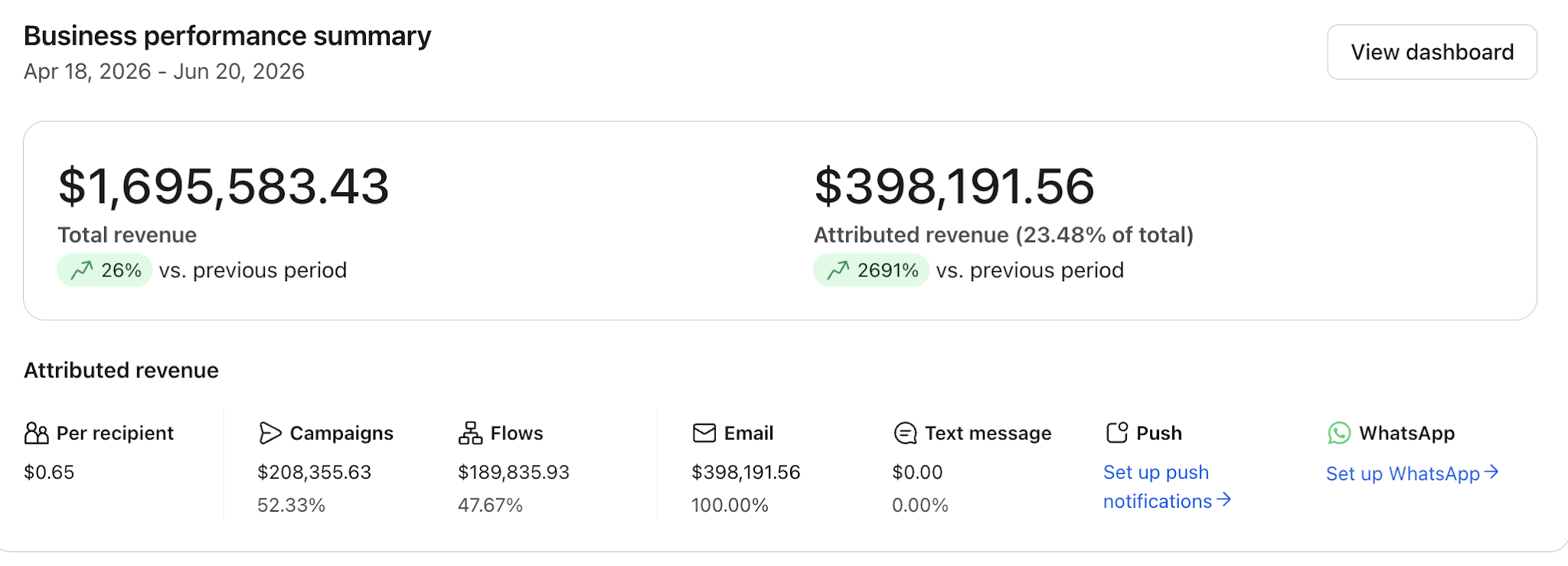
Source: In-box client account (Dermavenue)
3. Treat paying users and free users as two different audiences
Across our clients, roughly 80% of campaign revenue comes from existing customers. For one eight-figure brand, a single campaign made $7,262 from previous buyers and $640 from people who had never purchased before.
The same principle applies to subscription apps. Paying users, free users, and users who cancelled should all receive different emails. Paying users need reasons to stick around, while free users need to be convinced to subscribe.
If you're sending the same discount to everyone, you'll lose revenue from people who would have happily paid full price.
4. Send a plain-text email from a real person
The best-performing post-purchase email we send is as simple as it gets. It's a plain-text email from the founder that arrives around 20 minutes after an order without images or links. We just send a short thank-you, and people often reply.
Ask one question in that email, such as "What made you sign up today?" and you'll get onboarding research for free. You'll also get a sender reputation boost, because replies tell inbox providers people want your emails.
5. Win back before you sunset
Our win-back flows start around 45 days after a customer's last order. For an app, the trigger should be the last session or the cancellation date. Instead of sending a generic "we miss you", recommend something specific to what they previously used.
Then, for people who still don't engage, run a sunset flow. First, send a short plain-text email with a reason to come back. If there's no response after a second attempt around 48 hours later, stop emailing them completely.
Continuing to email people who haven't engaged in months hurts deliverability. Our guide to email deliverability explains why that matters more than any subject line.
Where to start
Pick the moment with the highest intent and the least coverage. For most subscription apps, that's the abandoned paywall. Set up one trigger, three short emails, and a holdout group so you can see what this flow really contributes.
In ecommerce, people who were already close to buying are often the easiest to convert, and the same goes for people who reach your paywall on a subscription app.
About the author
Gavin Hewitson is the founder of In-box, a Klaviyo Master Gold Partner email and SMS agency. Over five years, he and his team have worked with more than 500 ecommerce brands. See their results at in-box.com/case-studies.
Related
We help consumer apps and products reach their next phase of growth.
Growth notes, in your inbox
New writing on subscription growth and product-led strategy when I have something worth saying. No spam.