Wellness and education app retention is a motivation problem, not a content problem
When an education or wellness app churns, the team reaches for more content. It rarely works, because the content was never the problem. Motivation is what leaks.

People buy an education or wellness product to feel they are investing in themselves, and that feeling is what carried them through the ad, the onboarding and the trial start. After that, the only thing that sustains them is visible progress toward their own goal. You cannot out-content that. So the fix is to hand progress back at every surface: the ad, the app store listing, onboarding, trial start, the first two days, and every session after.
Users don't churn because they ran out of content.
They churn because the reason they showed up faded.
Nobody buys a learning app for the content. They buy it to feel like they're investing in themselves. That feeling is the entire reason they clicked the ad, read the listing, sat through onboarding and started the trial. It carried them all the way in.
Then the learning starts, and learning is hard. Past that first payoff, the only thing that sustains someone is evidence they're getting closer to the goal they came in with.
When an education or wellness app has a retention problem, the team almost always reaches for more content. More lessons, more workouts, more guided meditations. It rarely moves retention.
Here's the part most teams get wrong: they treat this as a content problem. It isn't. It's a MOTIVATION problem, and the two get fixed in completely different places.
Meanwhile every founder is over here going 🤔 "why aren't users as motivated about this as we are?"
What you're actually competing with
It's a fight for attention against Netflix, TikTok, and every other low-effort dopamine hit. It boils down to making perceived value >> perceived effort, every single day, or you lose.
That framing matters because it tells you where the lever is. You aren't going to win by making your product more entertaining than TikTok. You win by moving the other side of the inequality: making the value the user perceives from a session obviously larger than the effort it costs them. Most content investment raises neither.
The motivation is what's leaking
Motivation peaks the day someone downloads: a new year, a health scare, a goal, a burst of guilt. Then it decays, fast. If the only thing holding the user is that first burst of motivation, you lose them the week it wears off, no matter how good the library is.
The scale of this is easy to underestimate. Only about 25% of people stay committed to a self-improvement goal beyond thirty days. The average person's motivation peaks on Monday and falls roughly 23% by Wednesday. And when you ask people what actually stops them, 67% name the same thing: not a lack of time or money, but a lack of motivation. That is the real opponent, and no amount of content beats it.
You cannot out-content a motivation problem
You have seen the cycle. Launch the product, focus on content quality, expand the catalog, hit a retention wall somewhere around thirty to forty percent, scramble for solutions, and repeat. Each loop adds more content, and none of it touches the thing that is actually leaking.
Piling on content adds choice, not motivation, and choice is not what a demotivated user needs. Sometimes more content makes it worse, because a bigger library is a bigger decision, and a demotivated person does not want a decision. They want a reason to open the app today that does not depend on willpower they no longer have.
Onboarding should build buy-in, not just familiarity
Most onboarding teaches the user where the buttons are. That is familiarity, and it does nothing for the curve above. What you want out of those first few screens is commitment, and there are three ways to get it.
Explicit goal setting: ask how many hours a day they want to learn, or how many sessions a week they want to hit, and make them pick a number. Opt-in accountability: ask whether they want a daily reminder, and let them say yes rather than defaulting them into it. And challenge-based commitment: ask what streak they want to hit this week, so the target is theirs and not yours.
Most apps do one of the three. The real lift comes from combining all of them, because each one gives you something to reflect back later, and the reflecting back is where retention actually comes from.
The first 48 hours make or break it
If a user has not felt real value inside that window, they are gone, and nothing you send in week three brings them back. So push. Get them through as many lessons or sessions as you can, with roughly three touchpoints a day across email and push.
Some users will find that annoying. Do it anyway. The alternative is a polite cadence that respects an inbox belonging to someone who has already churned.
Close the goal loop
Here is the one that moves retention more than anything else on this list, and it has nothing to do with the size of your library.
After every session, remind the user of the goal they set and show them how far they have come against it. They told you they wanted four sessions a week. Show them they are at three. They said they wanted to hold a conversation by spring. Show them the ground they have covered since January.
Across the education and wellness apps I have worked with, closing that loop is worth something in the range of a 2-3x improvement in retention. Nothing else in this article is close. It works because motivation does not have to be regenerated from scratch every day if the product keeps handing the original reason back to the user with evidence attached.
Habit-anchoring helps here as a supporting move. Attach the session to a routine the user already runs without thinking, the morning coffee, the commute, the moment before bed, and the loop has something reliable to run on. One product I work with is Spotify meets Duolingo: you learn a language through the music you were going to put on anyway, so the session rides a habit that already exists instead of demanding a new one. That gets them to the session. Closing the loop is what makes the session worth repeating.
Progress has to be handed back at every surface, not just in the app
Closing the loop after a session is where most of the value is, and it is not the only place the loop exists. The user's goal is what you sold them in the first place, so it has to show up everywhere you talk to them. Not stated once and dropped: reinforced at every surface, so the thing they are working toward is in front of them from the ad all the way through onboarding.
The chain, in order:
The ad. Sell the goal they're buying into, because that is the thing they are actually paying for.
The app store listing. The value they came for, in the words they would use for it. Someone lands here straight off the ad and decides whether this is the thing that gets them there, so the listing has to be about their goal and not your feature list.
Onboarding. Ask for the goal, with a number. If you never ask, you have nothing to hand back later, and neither does anything else in the product.
Trial start. Repeat their number back to them, so the trial is framed as progress toward their goal rather than a countdown to a charge.
Days zero to two. First evidence, fast. This is the 48-hour window above, and what it is really for is proving the goal is moving.
Lifecycle email, and every session after. The goal they set, and how far they have come against it.
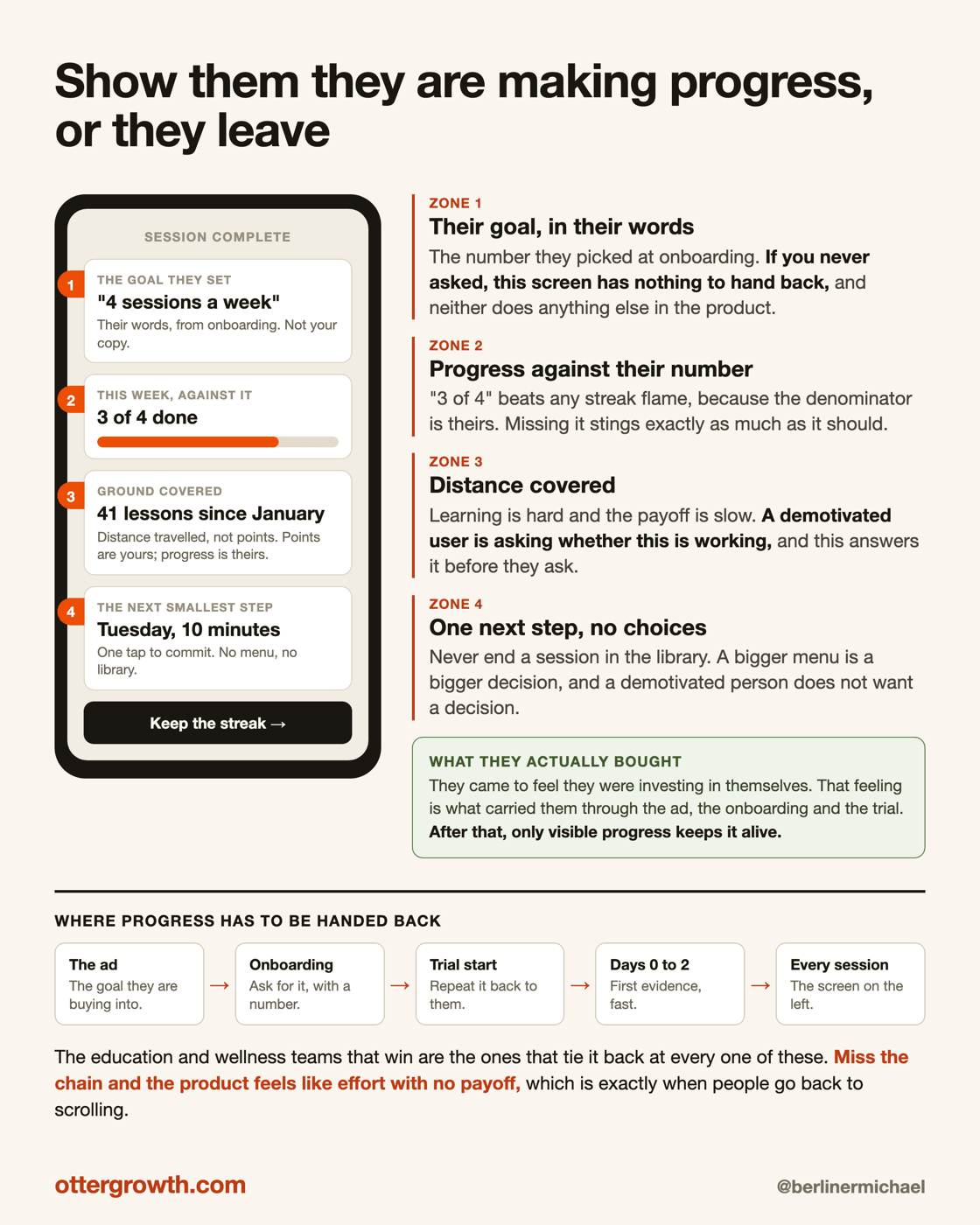
Miss a link in that chain and the product starts to feel like effort with no payoff, which is exactly when people go back to scrolling.
The takeaway
If your education or wellness app is churning, do not start with the content library. Start with motivation. It peaks at download and decays no matter what, so your job is to hold it above the line the user needs to keep coming back. Get explicit buy-in during onboarding, push hard through the first 48 hours, close the goal loop after every session, and hand that progress back at every surface leading in, from the ad onward. Stop trying to out-content a problem that was never about content.
Learning will always be harder than scrolling. Always. But when someone can see they're actually progressing, the effort starts to feel worth it.
Common questions
Why do education and wellness apps churn even with great content?
Because retention is driven by motivation, not library size. The motivation someone feels at download decays, and if nothing holds it up, they leave regardless of how good the content is.
How do you actually improve retention in a wellness app?
Close the goal loop, and close it everywhere rather than only in-app. The same goal runs through the ad, the app store listing, onboarding, trial start, the first two days and every session after. Get an explicit goal, an opt-in reminder and a challenge commitment out of onboarding, push hard through the first 48 hours, and then after every session show the user the goal they set and how far they have come against it. Anchoring the session to an existing daily habit is a good supporting move, because it gets them there without spending willpower.
Does adding more content improve retention?
Rarely. More content adds choice, not motivation, and a demotivated user does not want another decision. It can even hurt by making the app feel like more work.
Related
We help consumer apps and products reach their next phase of growth.
Growth notes, in your inbox
New writing on subscription growth and product-led strategy when I have something worth saying. No spam.